Best STALKER 2 Settings for FPS and Performance
Published
On this page
The fastest way to boost FPS in STALKER 2 is to set Global Illumination (Lumen) and Shadow Quality to Medium or Low, enable DLSS or FSR on Quality, and run a stable FPS cap. STALKER 2 is an Unreal Engine 5 open-world shooter built around upscaling, so these changes recover the most frames while keeping the Zone readable. This guide covers the best graphics, upscaling, and Windows settings for any PC.
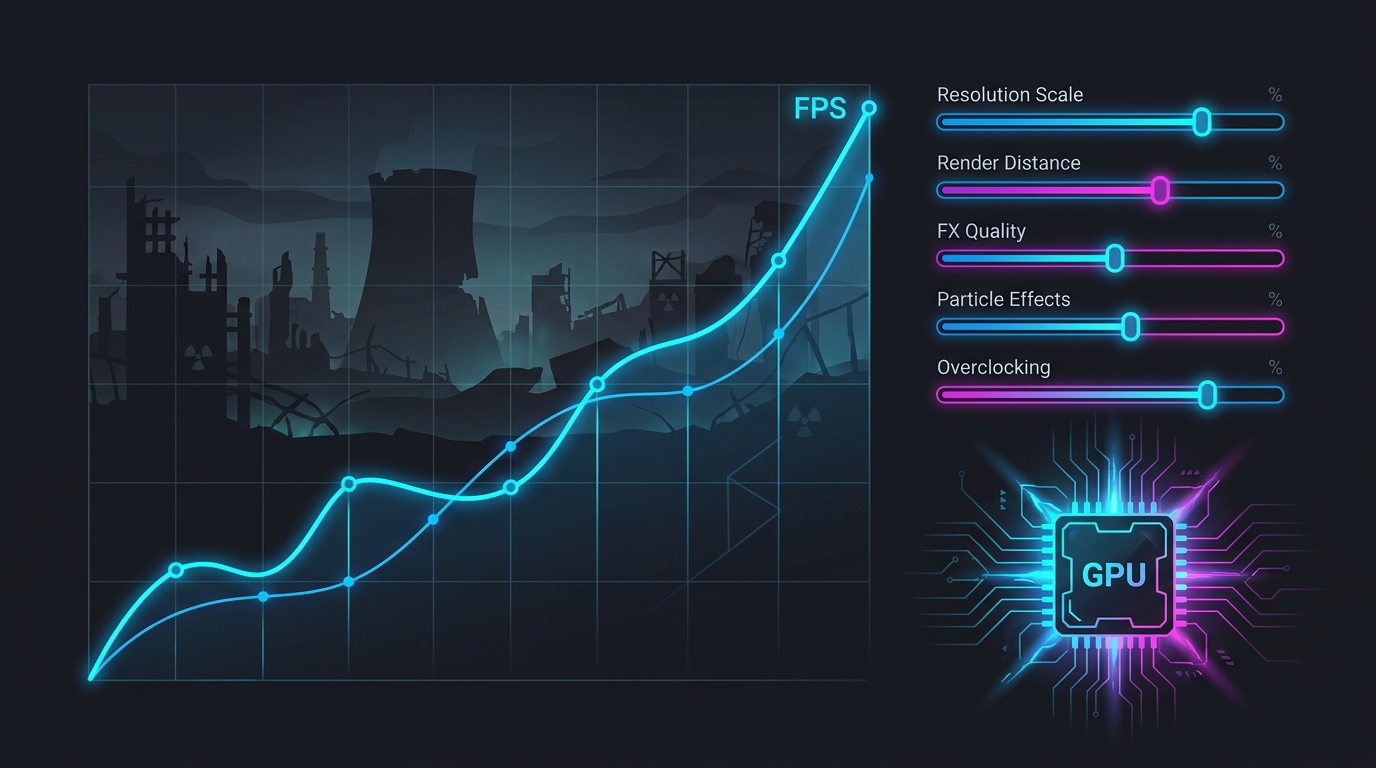
The goal is stable, playable frames across the open Zone — not maxed Lumen lighting that tanks your FPS the moment you step outside.
Best STALKER 2 settings
Set these in Settings → Video:
| Setting | Recommended value |
|---|---|
| Display Mode | Fullscreen |
| V-Sync | Off |
| Frame Rate Limit | Cap slightly below refresh |
| Upscaling | DLSS / FSR / XeSS — Quality |
| Frame Generation | On only above ~50 FPS base |
| Global Illumination Quality | Medium or Low |
| Shadow Quality | Low–Medium |
| Effects Quality | Medium |
| Texture Quality | High (drop to Medium on 8 GB VRAM) |
| Anti-Aliasing | TSR / DLSS AA |
| Reflection Quality | Low |
| Volumetric Fog / Clouds | Low |
| Motion Blur | Off |
| Depth of Field | Off |
| Foliage Quality | Medium |
The most expensive settings are Global Illumination (Lumen), Shadow Quality, Effects Quality, and Reflections — lower these first for the biggest FPS gain with the least visual loss.
Why STALKER 2 is so demanding
STALKER 2 runs on Unreal Engine 5 and uses software Lumen global illumination, which is beautiful but expensive. On top of that, the open Zone and A-Life NPC simulation load the CPU hard in towns and combat. The result is a game that is GPU-bound outdoors and CPU-bound in busy areas, so both halves of your PC need headroom. These settings ease the GPU while the Windows checks below free up the CPU.
Display and frame pacing first
These give the biggest improvement instantly:
- Use Fullscreen for the lowest input delay.
- Turn V-Sync off to avoid added latency — cap your FPS instead.
- Cap your frame rate for even frame times (see the caps below).
- Turn Motion Blur and Depth of Field off for a cleaner, more responsive image.
Good FPS cap starting points
60 FPSfor 60 Hz117 FPSfor 120 Hz141 FPSfor 144 Hz
A stable cap below your refresh keeps frame times even and reduces traversal stutter. For the reasoning, see How to Cap Your FPS Correctly.
Upscaling is essential in STALKER 2
STALKER 2 is designed around upscaling — treat it as a core setting, not a fallback.
- Start with DLSS/FSR/XeSS on Quality for a large FPS boost with minimal clarity loss.
- Drop to Balanced at 1080p only if Quality still isn’t enough.
- Enable frame generation only once your base frame rate is around 50–60 FPS — it adds latency and artifacts below that.
For the full breakdown of which upscaler to pick, see DLSS vs FSR vs XeSS for Gaming.
Graphics settings that matter most
Lower these first — they cost the most performance for the least value in a firefight:
- Global Illumination (Lumen)
- Shadow Quality
- Effects Quality
- Reflection Quality
- Motion Blur and Depth of Field
Keep Texture Quality high if your VRAM allows — textures are nearly free on frame rate but a big clarity boost. Drop to Medium only if you have 8 GB of VRAM and see hitching.
Best settings by goal
Smoother 1080p on a weaker PC
- Lumen, shadows, effects, and reflections to Low
- FSR/DLSS Balanced on
- textures down a step if frame times get messy
- sensible FPS cap, frame generation on if your base is stable
Cleaner high-refresh setup
- DLSS Quality, Lumen and shadows to Medium
- effects Medium, reflections Low
- prioritize stable frame times over ultra lighting
Windows-side checks worth doing
- Install STALKER 2 on an NVMe SSD — it streams the open Zone constantly and traversal stutter is worse on slow drives.
- Let shaders finish compiling on a fresh session to avoid first-run hitching. See Clear Shader Cache to Fix Stuttering if hitching persists.
- Close overlays, browsers, and capture tools you don’t need.
- Use the correct discrete GPU on laptops and set a high-performance power mode.
- Disable VBS for extra CPU headroom — STALKER 2 is CPU-bound in towns and combat.
For deeper system tuning, use How to Minimize Input Delay for Competitive Gaming and The Ultimate Guide to Timer Resolution for Gaming + Tier1Suite.
Build your STALKER 2 cluster
Related guides
- How to Cap Your FPS Correctly
- DLSS vs FSR vs XeSS for Gaming
- How to Disable VBS to Fix Low FPS in Games
The best STALKER 2 settings keep your frame rate playable across the whole Zone. Drop Lumen global illumination, shadows, and effects first, keep textures high if your VRAM allows, lean on Quality upscaling, and cap your FPS to smooth out the traversal stutter that comes with wild frame swings.
Frequently asked questions
What settings give the most FPS in STALKER 2?
Global Illumination (Lumen), Shadow Quality, and Effects Quality are the heaviest settings in STALKER 2. Lowering these three from Epic to Medium or Low reclaims the most FPS because STALKER 2 runs on Unreal Engine 5 and spends most of its budget on software Lumen lighting and long-range shadows.
Should I use DLSS or FSR in STALKER 2?
Yes — STALKER 2 is built around upscaling and expects you to use it. Use DLSS on NVIDIA RTX cards and FSR on AMD or older GPUs. Set the upscaler to Quality at 1440p and 4K, or Balanced at 1080p if you still need frames. Upscaling gives the single largest FPS boost in STALKER 2.
How do I stop STALKER 2 from stuttering?
Most STALKER 2 stutter is Unreal Engine 5 shader compilation and traversal hitching as you cross the open Zone. Cap your FPS for even frame times, install the game on an NVMe SSD, keep textures within your VRAM budget, and let shaders compile on a fresh session. See our dedicated STALKER 2 stuttering fix for the full checklist.
Is STALKER 2 CPU or GPU heavy?
STALKER 2 is both, but the open Zone and A-Life NPC simulation make it CPU-bound in towns and busy areas, while Lumen global illumination makes it GPU-bound outdoors. Lower Lumen and shadows to ease the GPU, and disable VBS plus close background apps to give the CPU headroom for the simulation.
What is a good FPS cap for STALKER 2?
Cap slightly below your refresh rate — 60 for 60 Hz, 117 for 120 Hz, 141 for 144 Hz. STALKER 2 swings between quiet interiors and demanding outdoor areas, so a stable cap keeps frame times even and reduces the traversal stutter that comes from wild FPS swings.