CRT vs LCD vs OLED for Gaming: Lag, Motion, and Image
Published
On this page
Every display technology trades something. A CRT wins on motion and lag but loses on size and resolution. An LCD is the affordable all-rounder. An OLED brings stunning image quality and fast response but has its own quirks. Here’s how the three compare on what actually matters for gaming, and which one wins for competitive play.
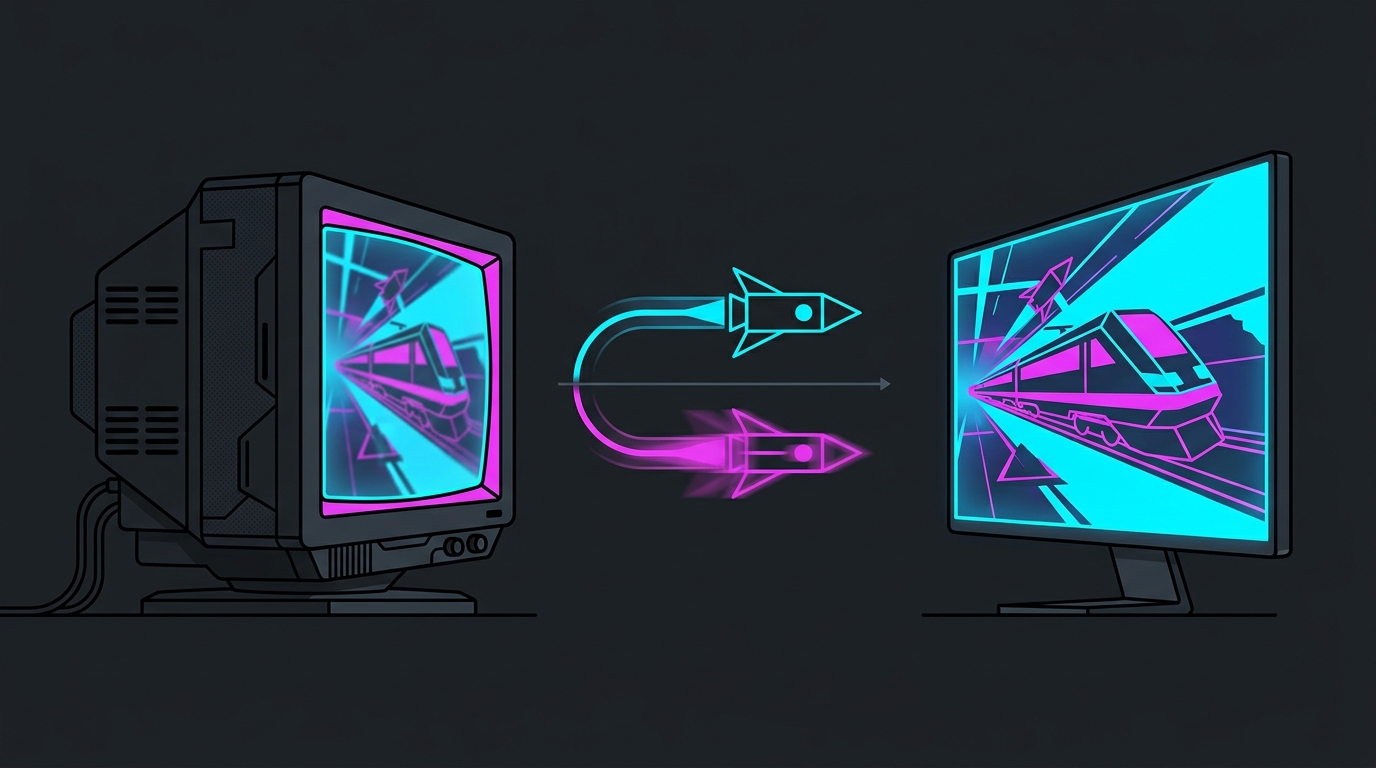
The CRT is the motion and latency king; OLED is the modern all-rounder; LCD is the value pick.
Quick comparison
| Factor | CRT | LCD | OLED |
|---|---|---|---|
| Display input lag | Effectively zero | Low–moderate | Very low |
| Motion clarity | Best (impulse) | Blur unless strobed | Very good, mild sample-and-hold blur |
| Pixel response | Instant | 1–5 ms (varies) | ~0.1 ms |
| Max resolution | ~1080p-class | Up to 4K+ | Up to 4K+ |
| Refresh flexibility | Any res/refresh, no scaling | Fixed native res | Fixed native res |
| Size / weight | Bulky, heavy | Thin | Thin |
| Burn-in risk | Phosphor wear (rare) | None | Possible |
| Availability | Used only | Everywhere | Widely available |
Input lag
The CRT paints the signal as it arrives — no buffer, no scaler, effectively zero display latency. OLED is extremely close thanks to near-instant pixel response and minimal processing. LCD varies: the best competitive panels are excellent, but slower or heavily-processed panels add noticeable delay. If display latency is your only metric, the CRT still wins, but a good OLED is within a hair.
Remember the display is only part of the chain — see how to measure input lag and how to minimize input delay for the rest.
Motion clarity
This is the CRT’s biggest edge. LCD and OLED are sample-and-hold — a frame stays lit until the next one, and your eye blurs it while tracking motion. A CRT is an impulse display: it flashes each frame and goes dark between scans, so motion stays razor-sharp. Modern panels fake this with backlight strobing (ULMB, DyAc, ELMB), which gets close but sacrifices brightness and can’t run alongside variable refresh. OLED has faster pixels than LCD but still carries mild sample-and-hold blur at lower refresh rates.
Resolution and size
Here the modern panels win easily. A CRT tops out around 1080p-class resolutions and is limited to roughly 19–24” of heavy glass. LCD and OLED scale to 4K and beyond at any size you want, thin and light. If you want a big, sharp desktop or single-player eye candy, a flat panel is the obvious pick.
Refresh flexibility
A CRT has no native resolution, so it can run any resolution and refresh combination up to its limits with no upscaling blur — drop the resolution, gain refresh, keep a crisp image. Flat panels have a fixed native grid, so running non-native resolutions means scaling (blur) unless you use a trick like stretched resolution. This flexibility is a real CRT advantage for competitive players who chase refresh over pixel count.
Image quality
OLED is the clear winner on contrast, HDR, and color — perfect blacks and per-pixel lighting. CRT has deep blacks and a pleasing phosphor look but lower sharpness and resolution. LCD sits in the middle and depends heavily on the panel and backlight. For cinematic single-player games, OLED is stunning; for fast competitive motion, the CRT’s clarity often matters more than outright image fidelity.
The verdict
- Pure competitive motion + lowest lag, and you can source one: CRT still wins.
- Best modern all-rounder: high-refresh OLED — near-CRT response with modern resolution and size.
- Best value / brightness / no burn-in worry: a fast LCD, ideally with backlight strobing.
Many pros run flat panels today purely for convenience and availability — but the reason CRTs are making a comeback is that on motion and latency, the old glass still hasn’t been beaten.
Related guides
Frequently asked questions
Is a CRT better than OLED for gaming?
For pure motion clarity and display input lag, a CRT still edges out OLED — it's an impulse display with no sample-and-hold blur and no processing delay. OLED wins on resolution, size, brightness, HDR, and convenience, and its response time is excellent. For fast competitive play a CRT is arguably still the motion king; for everything else, a high-refresh OLED is the better all-rounder.
Do CRTs have less input lag than LCD or OLED?
Yes, from the display itself. A CRT has no frame buffer or scaler, so it paints the signal instantly with effectively zero added latency. Fast modern LCDs and OLEDs add a small amount of processing and, on LCDs, pixel-response time. The gap is small on the best modern panels but the CRT is still the lowest-latency display technology.
Why does motion look blurry on LCD and OLED but not CRT?
LCD and OLED are sample-and-hold: each frame stays lit until the next one appears, and your eye smears that static frame into blur as it tracks motion. A CRT flashes each frame briefly and goes dark between refreshes (impulse display), which your eye reads as sharp. Backlight strobing (ULMB, DyAc) mimics this on modern panels but costs brightness.
Should a competitive gamer use a CRT, LCD, or OLED?
If you can source a good CRT and value motion clarity above all, it's still unmatched for fast shooters. Otherwise a high-refresh OLED (or a fast LCD with backlight strobing) is the practical choice — near-CRT response with modern resolution, size, and reliability. Many pros run high-refresh flat panels today simply for convenience and availability.